

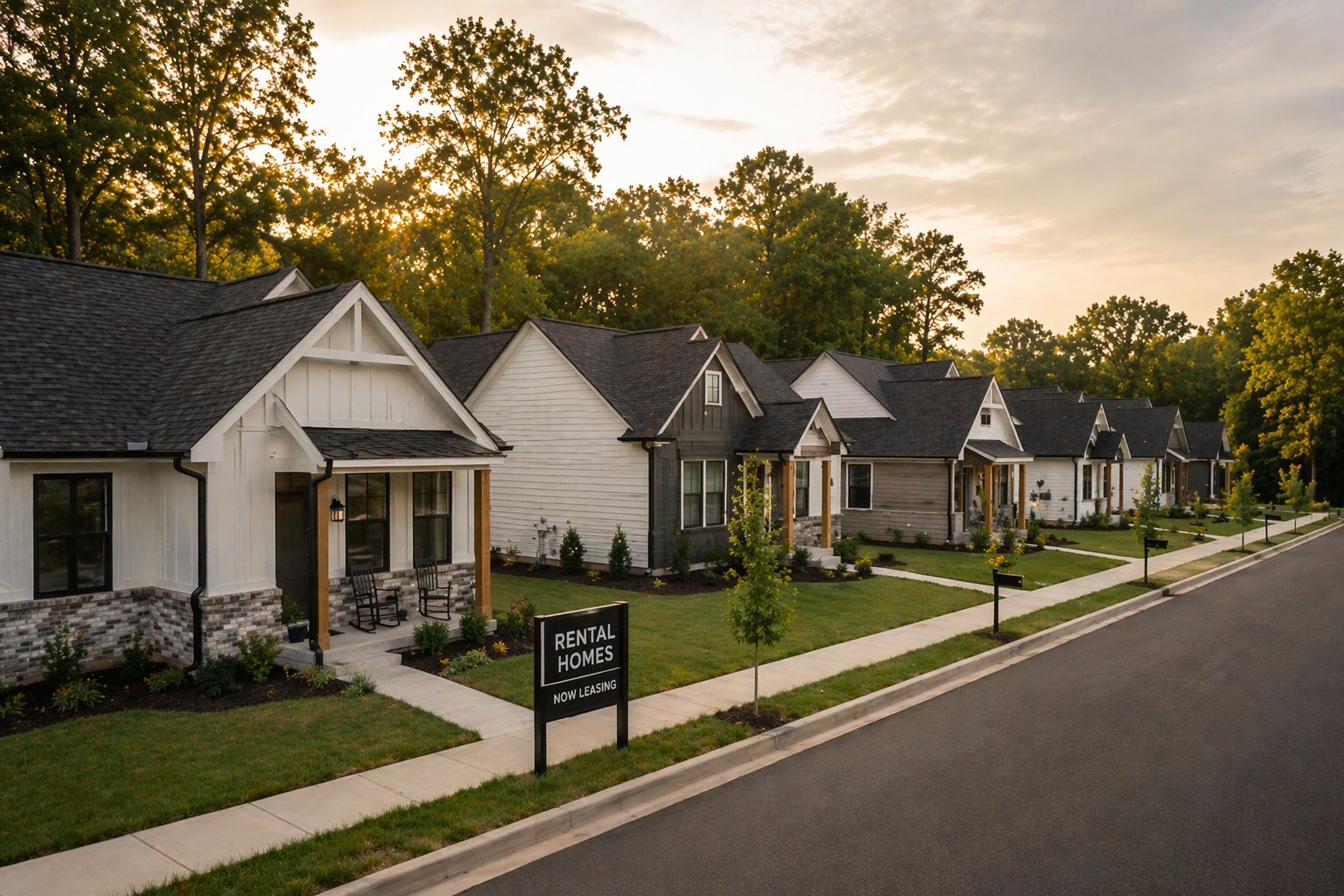
The Rise of Build-to-Rent Communities
Over the past several years, Build-to-Rent (BTR) has become one of the fastest-growing segments of the residential real estate market. Large institutional investors have poured billions of dollars into building entire neighborhoods designed specifically for renters rather than homeowners. These communities often include rows of single-family homes or townhomes that function like apartment complexes but offer more privacy and space.
Institutional capital has allowed large funds to dominate headlines in the BTR sector. Massive developments with hundreds of homes are appearing in markets across Texas, the Southeast, and parts of the Midwest. For many smaller investors, it may seem as though this strategy is reserved only for large real estate firms with deep pockets.
But the reality is that build-to-rent opportunities are not limited to institutions. In fact, individual investors and small developers may actually hold several strategic advantages that allow them to compete effectively in this space.
Why Demand for Build-to-Rent Housing Keeps Growing
The growth of build-to-rent communities is largely driven by changing housing preferences. Many renters want the space, privacy, and lifestyle benefits of a single-family home but are not yet ready, or able, to purchase one. Rising home prices and mortgage rates have pushed many households toward renting for longer periods of time.
Build-to-rent properties offer a middle ground between apartments and homeownership. Residents gain access to features such as private entrances, small yards, garages, and multiple bedrooms while maintaining the flexibility of renting.
This demand has created strong rental markets for newly constructed homes, particularly in growing suburban and secondary metro areas where population growth continues to outpace housing supply.
The Institutional Advantage, and Its Limitations
Large institutional investors dominate the BTR headlines because they have access to enormous pools of capital. They can acquire large tracts of land and develop hundreds of homes at once, creating entire rental neighborhoods in a single project.
However, this scale also creates limitations. Institutional developers often require long approval processes, complex financing structures, and multi-year development timelines. Because their projects must meet strict investment criteria and internal approvals, they are less able to move quickly on smaller opportunities.
This is where smaller developers and individual investors can find an advantage.
The Opportunity for Small-Scale BTR Development
Instead of competing directly with massive developments, many independent investors are focusing on “pocket communities.” These smaller build-to-rent projects typically include two to four rental homes built on a single parcel of land or within a small subdivision.
A pocket BTR development may consist of:
- A duplex or triplex designed for long-term rental
- Four small single-family homes on adjacent lots
- A row of townhomes built for rental income
Because these projects are smaller in scale, they can often be approved, financed, and constructed much faster than institutional developments.
This agility allows independent investors to move into neighborhoods and markets that are too small to attract major institutional attention but still offer strong rental demand.
How New Construction Loans Enable Small Developers
Financing is often the biggest challenge for small developers entering the build-to-rent space. Traditional banks can be hesitant to fund speculative construction projects, particularly when the borrower plans to hold the property as a rental investment.
This is where private construction loans become a powerful tool.
Construction financing from private lenders allows investors to fund land acquisition and building costs while maintaining the flexibility needed to complete smaller projects efficiently. Rather than navigating rigid institutional underwriting, investors can structure financing around the specific project timeline and development plan.
For developers building pocket communities, this type of financing allows them to compete with larger players by moving quickly and controlling their own development schedule.
The Build-to-Rent Development Strategy
Small-scale build-to-rent projects often follow a straightforward strategy. The developer identifies a parcel of land in a growing neighborhood with strong rental demand. The site is then developed into a small cluster of rental homes designed for long-term tenants rather than resale.
Once construction is complete, the homes are leased to tenants who prefer the space and privacy of a house while remaining renters. These properties often attract families, remote workers, and young professionals who want more room than a typical apartment provides.
After stabilization, the investor may refinance the completed project into long-term rental financing, allowing them to hold the property for consistent income while redeploying capital into future developments.
Why Agility Beats Scale in Many Markets
Institutional investors rely on scale to achieve efficiency. However, that same scale can slow decision-making and limit flexibility. Smaller developers can often outperform larger firms simply by moving faster and focusing on targeted opportunities.
Independent investors can identify underutilized parcels, smaller development sites, and emerging neighborhoods long before large funds enter the market. They can also tailor their designs to local demand, creating rental homes that better fit the surrounding community.
In many cases, the ability to execute quickly and adapt to local market conditions provides a powerful competitive advantage.
The Future of Build-to-Rent for Independent Investors
The build-to-rent sector is expected to continue expanding as housing affordability challenges persist across the country. While institutional investors will remain major players in large-scale developments, smaller developers are increasingly carving out their own niche within the market.
By focusing on smaller projects, targeting emerging neighborhoods, and leveraging flexible construction financing, independent investors can participate in one of the fastest-growing housing segments without competing directly against massive institutional funds.
The Bottom Line: Small Developers Can Win in BTR
Build-to-rent is no longer just an institutional strategy. Individual investors and small developers have the ability to compete effectively by focusing on smaller, high-demand projects that large funds often overlook.
Pocket communities of two to four homes can deliver strong rental income while maintaining manageable development costs and timelines. With the right construction financing and a strategic development plan, smaller investors can capture the same rental demand driving institutional growth in the BTR sector.
In today’s evolving housing market, agility and speed can be just as valuable as scale.
This article is general information for real estate investors, not legal, tax or financial advice. Swift Capital makes business-purpose loans on non-owner-occupied investment property; every loan is subject to underwriting, appraisal and approval.